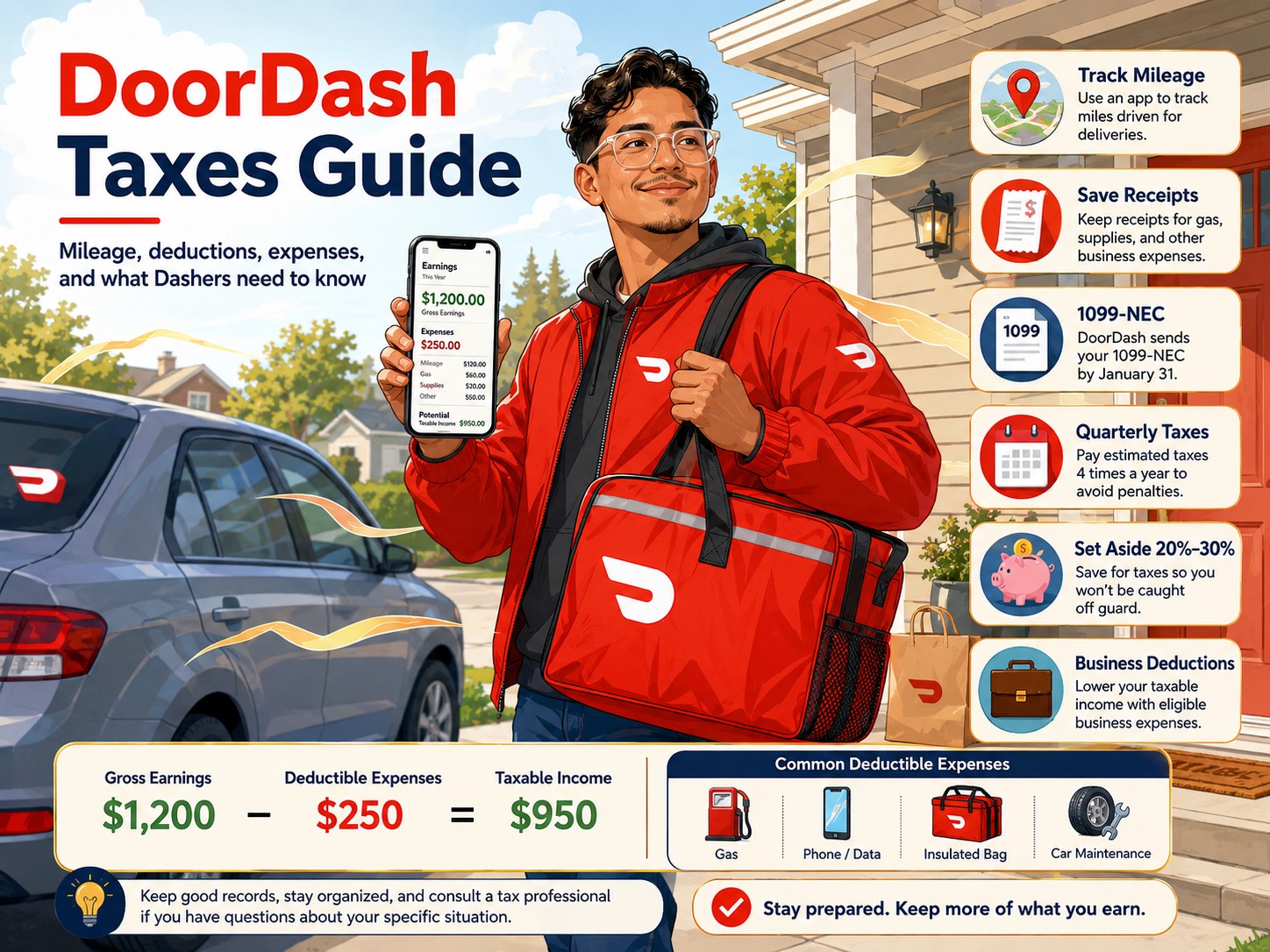
When you first start driving for DoorDash, taxes may be the last thing on your mind.
You are probably more focused on learning the Dasher app, finding restaurants, completing deliveries and figuring out which orders are worth accepting.
Then tax season arrives.
You realize DoorDash did not withhold federal income tax, Social Security tax or Medicare tax from your payouts. You also need to organize your mileage, expenses, earnings statements and Form 1099-NEC.
This can be overwhelming, especially when you are used to working a regular job where an employer handles payroll withholding.
The good news is that DoorDash taxes are manageable when you keep records throughout the year. You do not need to become a tax expert, but you should understand how self-employment income, mileage deductions, business expenses and estimated payments work.
This DoorDash Taxes Guide 2026 explains the major federal tax topics US Dashers should know, including:
- How DoorDash income is taxed
- When you receive Form 1099-NEC
- What happens when you earn less than $600
- The 2026 mileage deduction rates
- Standard mileage versus actual vehicle expenses
- Common DoorDash tax deductions
- Self-employment tax
- Quarterly estimated-tax deadlines
- The federal deduction for qualified tips
- How to organize your records
- Common tax mistakes made by Dashers
Tax situations differ based on income, state, filing status, family circumstances and other jobs. This article provides general educational information, not personalized tax advice. Consider working with a qualified tax professional when you are unsure how a rule applies to you.
Do DoorDash Drivers Have to Pay Taxes?
Yes.
Money you earn from DoorDash is generally taxable income.
This remains true when your DoorDash work is:
- Part-time
- Temporary
- A weekend side hustle
- Your full-time source of income
- Not reported on a tax form
- Paid through direct deposit
- Paid through DoorDash Crimson
- Received through Fast Pay
- Received as a cash tip
The IRS says gig-economy income must be reported even when it comes from temporary or part-time work, is paid in cash or is not shown on an information return such as Form 1099-NEC.
Earning money outside a traditional payroll job does not make it tax-free.
Are DoorDash Drivers Employees or Independent Contractors?
US Dashers generally perform deliveries as independent contractors.
This means DoorDash does not normally treat you like a traditional employee receiving a regular paycheck. DoorDash does not automatically withhold taxes from your Dasher earnings, and Dashers are responsible for tracking and reporting their own income and business expenses.
As an independent contractor, you may be responsible for:
- Federal income tax
- Self-employment tax
- State income tax
- Local income or business taxes
- Quarterly estimated-tax payments
- Keeping business records
- Tracking mileage
- Reporting cash tips and other income
You may also qualify to deduct ordinary and necessary business expenses connected to your delivery work.
DoorDash Taxes Are Generally Based on Profit
One of the most important concepts for new Dashers is the difference between gross income and net profit.
Gross DoorDash income
Gross income is the total business income you received before subtracting deductible expenses.
It may include:
- Base pay
- Peak Pay
- Challenges
- Delivery streaks
- Bonuses
- Adjustments
- Customer tips
- Cash tips
- Other taxable incentives
Net DoorDash profit
Net profit is generally your business income minus allowable business expenses.
A simplified calculation looks like this:
DoorDash income − deductible business expenses = net business profit
Suppose you received $30,000 from DoorDash during the year and had $10,000 in allowable business expenses.
Your simplified Schedule C profit would be:
$30,000 − $10,000 = $20,000
Your federal income tax and self-employment tax calculations generally begin with the business profit rather than simply taxing the entire $30,000 without considering expenses.
You report sole-proprietor business income and expenses on Schedule C. When total net earnings from self-employment reach $400 or more, Schedule SE is generally used to calculate self-employment tax.
What Tax Form Does DoorDash Send?
Eligible US Dashers generally receive Form 1099-NEC.
The form summarizes the nonemployee compensation DoorDash reports under your taxpayer information.
DoorDash currently says that you will receive a 1099-NEC when you earn $600 or more between January 1 and December 31 on the platform. The form is provided to you, the IRS and relevant state tax authorities when required.
Your 1099-NEC is not a tax bill.
It is an information form showing income reported under your Social Security number or taxpayer identification number.
How to Get Your DoorDash 1099-NEC
DoorDash says eligible Dashers can access Form 1099-NEC through the Dasher app.
The current process is:
- Update to the latest version of the Dasher app.
- Open the Earnings tab.
- Tap View payout details.
- Select Tax documents.
- Choose the appropriate tax year.
- Open the form.
- Save, print or share the PDF.
DoorDash says the tax form should be available by January 31. Dashers who opt out of electronic delivery may receive a paper copy by mail.
For 2026 earnings, look for your tax information around the end of January 2027.
What If You Earn Less Than $600?
When you earn less than $600 from DoorDash during the calendar year, DoorDash generally does not issue a 1099-NEC.
That does not mean the income disappears or becomes automatically tax-free.
The IRS requires taxpayers to report taxable gig income even when no Form 1099 is provided. A federal return may generally be required when your net earnings from all self-employment activities total $400 or more. Other filing requirements may also apply based on your complete income and filing situation.
For example, suppose you earned:
- $450 from DoorDash
- $500 from Uber Eats
- $300 from another delivery app
You may not receive a 1099 from every platform, but you still earned $1,250 of gross business income before expenses.
Do not use the $600 information-reporting threshold as a rule for deciding whether income is taxable.
What If You Drive for Multiple Apps?
Many delivery drivers work for more than one platform.
You may receive separate forms from:
- DoorDash
- Uber Eats
- Grubhub
- Instacart
- Spark Driver
- Amazon Flex
- Shipt
- Other delivery or gig platforms
You generally need to report income from all your business activities, including income that did not produce a 1099.
Depending on how closely related your activities are, your tax professional or tax software may report them on one Schedule C or separate Schedules C.
Keep each company’s earnings reports and tax forms organized. Do not report only the largest 1099 and ignore the rest.
Does DoorDash Report Tips Separately?
DoorDash says that, because of the federal qualified-tips deduction, it now provides US Dashers with separate information about their DoorDash tip income.
The regular 1099-NEC may not provide a complete breakdown between:
- Base pay
- Promotions
- Bonuses
- Tips
- Other compensation
DoorDash says eligible US Dashers receive an email by January 31 reporting their total tips for the year.
Save this email with your tax documents.
You may need it when determining whether you qualify for the federal deduction for qualified tips.
Check Your DoorDash Tax Information Before December 31
Before the calendar year ends, confirm that DoorDash has your correct:
- Legal name
- Social Security number or taxpayer identification number
- Mailing address
- Email address
- Phone number
DoorDash advises Dashers to verify their physical address in the app by December 31. Corrections involving a name, taxpayer identification number or move to another state may require help from Dasher Support.
Do not wait until tax filing season to discover that your old address or incorrect name is attached to the account.
What If Your DoorDash 1099 Is Wrong?
Compare the form with:
- Your monthly DoorDash earnings statements
- Bank deposits
- DoorDash Crimson records
- Fast Pay transfers
- Your own spreadsheet
- Any taxable incentive or bonus records
Remember that DoorDash says it calculates the earnings subtotal based on the date earnings were deposited—not necessarily the date you completed the dash. DoorDash also says qualifying reimbursements are not included as taxable 1099 earnings.
When the form contains an incorrect name, taxpayer identification number, state or earnings amount, contact DoorDash Support.
Do not simply change the number on your copy of the form. The IRS receives the amount DoorDash reported, so unresolved differences can trigger questions later.
What If Your Dasher Account Was Deactivated?
A deactivated account does not remove your tax obligations.
DoorDash says deactivated Dashers who cannot access or download their 1099 through the app should contact Dasher Support.
You should still report your income even if:
- You stopped dashing
- You deleted the app
- You were deactivated
- You moved to another state
- You no longer have access to the original phone number
Keep your email address and tax information current whenever possible.
Federal Taxes DoorDash Drivers May Owe
DoorDash income can affect more than one type of federal tax.
Federal Income Tax
Federal income tax is based on your taxable income after applying relevant adjustments, deductions and credits.
The percentage depends on factors such as:
- Net DoorDash profit
- Income from other jobs
- Spouse’s income
- Filing status
- Dependents
- Tax credits
- Retirement contributions
- Health-insurance deductions
- Qualified business-income deductions
- Qualified-tip deductions
- Other taxable income
There is no single federal income-tax percentage that applies to every Dasher.
Self-Employment Tax
Self-employment tax generally covers Social Security and Medicare taxes for people working for themselves.
Traditional employees normally split these payroll taxes with an employer. A self-employed person generally pays both portions through the self-employment-tax calculation.
The combined self-employment-tax rate remains 15.3% in 2026:
- 12.4% for Social Security
- 2.9% for Medicare
The Social Security portion applies only up to the annual taxable maximum. For 2026, that maximum is $184,500. Medicare tax does not have the same earnings cap, and an additional Medicare tax can apply at higher income levels.
Self-employment tax is not usually calculated by simply multiplying all gross DoorDash revenue by 15.3%.
Schedule SE generally applies the tax to 92.35% of qualifying net self-employment earnings, subject to the Social Security wage limit and other rules.
You can generally deduct one-half of the self-employment tax as an adjustment when calculating federal income tax. That deduction does not eliminate the self-employment tax itself.
State and Local Taxes
Your state may impose:
- State income tax
- Local income tax
- City business tax
- County tax
- Self-employment registration requirements
- Business-license fees
Some states do not have an individual state income tax, but that does not eliminate federal obligations or every possible local requirement.
State treatment of mileage, qualified tips and other federal deductions may differ. Check the rules where you live and where you perform deliveries.
Do Dashers Need to Pay Quarterly Taxes?
Possibly.
The US tax system generally expects taxes to be paid throughout the year rather than entirely at filing time.
Individuals, including sole proprietors, generally need estimated payments when they expect to owe at least $1,000 in tax after subtracting withholding and refundable credits.
Estimated payments can cover:
- Federal income tax
- Self-employment tax
- Additional Medicare tax
- Other applicable federal taxes
You may not need quarterly payments when:
- Your DoorDash profit is small
- You have enough withholding from a W-2 job
- Your spouse has enough tax withheld
- Tax credits cover your liability
- You meet an applicable safe-harbor rule
- You are not expected to owe at least $1,000
Do not assume that every Dasher automatically pays the same quarterly amount.
2026 Estimated-Tax Due Dates
The regular federal estimated-tax dates for the 2026 tax year are:
| Income period | Payment due date |
|---|---|
| January 1–March 31, 2026 | April 15, 2026 |
| April 1–May 31, 2026 | June 15, 2026 |
| June 1–August 31, 2026 | September 15, 2026 |
| September 1–December 31, 2026 | January 15, 2027 |
These periods are not equal three-month calendar quarters. Notice that the second payment period covers only April and May, while the third covers June through August.
When a deadline falls on a weekend or legal holiday, it may move to the next business day.
How Much Should a Dasher Pay Quarterly?
There is no universal percentage.
Your payment depends on:
- Expected net business profit
- Other household income
- Filing status
- Tax bracket
- Credits
- Deductions
- State tax
- Prior-year tax
- W-2 withholding
- Self-employment-tax liability
A common practical habit is to transfer a percentage of each payout to a separate tax savings account.
Some drivers start by reserving 20% to 30% of profit, but that is only a rough planning range—not a guaranteed calculation. A driver with low income, dependents and tax credits may need less. A high-income driver in a high-tax state may need more.
Use Form 1040-ES, tax software or a tax professional to calculate a more accurate amount.
How to Avoid an Estimated-Tax Penalty
Many taxpayers can avoid the federal underpayment penalty when they:
- Owe less than $1,000 after withholding and refundable credits, or
- Pay at least 90% of the current year’s tax, or
- Pay at least 100% of the prior year’s tax, when eligible
Different rules may apply to higher-income taxpayers and people with uneven income.
Because delivery earnings can fluctuate, the annualized-income method may help when most of your money was earned during only part of the year.
Can You Increase Withholding at Your Regular Job Instead?
Yes.
When you or your spouse also has a W-2 job, increasing payroll withholding can be an alternative to sending separate estimated payments.
You can request additional withholding through Form W-4.
This approach may be easier because:
- Tax is removed automatically
- You do not need to remember every quarterly payment
- Withholding can help cover both W-2 and DoorDash tax obligations
Calculate the adjustment carefully. Do not guess based only on gross DoorDash income.
DoorDash Mileage Deduction for 2026
Vehicle mileage is often the largest potential business deduction for a Dasher.
The IRS changed the business mileage rate halfway through 2026.
The rates are:
- January 1 through June 30, 2026: 72.5 cents per business mile
- July 1 through December 31, 2026: 76 cents per business mile
The IRS revised the rate effective July 1, so Dashers need to separate first-half and second-half mileage.
Example of the 2026 Mileage Deduction
Suppose you drove:
- 5,000 eligible business miles from January through June
- 6,000 eligible business miles from July through December
Your potential mileage calculation would be:
First half
5,000 × $0.725 = $3,625
Second half
6,000 × $0.76 = $4,560
Total potential mileage deduction
$3,625 + $4,560 = $8,185
This is a deduction from business income—not an $8,185 refund.
The deduction reduces the profit used in calculating taxes. The actual tax savings depend on your tax situation.
Does the Mileage Rate Mean Your Car Costs 76 Cents per Mile?
Not necessarily.
The standard mileage rate is an IRS method for calculating a vehicle expense deduction. It incorporates estimated costs such as:
- Fuel
- Maintenance
- Repairs
- Insurance
- Depreciation
- Registration
- Other operating costs
Your personal vehicle may cost more or less to operate.
Do not confuse the mileage deduction with a reimbursement from DoorDash or the IRS.
What DoorDash Miles May Be Deductible?
Business mileage may include qualifying driving connected to your delivery activity, such as:
- Driving from a pickup to a customer
- Driving between delivery offers when you remain engaged in the business
- Driving from one merchant area to another for a business reason
- Driving to purchase delivery supplies
- Driving for qualifying business-related vehicle maintenance
The difficult question is often when business driving begins and ends.
Ordinary commuting between your home and a regular place of work is generally not deductible. Whether driving from home to your first pickup or from the last delivery home qualifies can depend on your specific facts, including whether you have a qualifying principal place of business at home. IRS vehicle and transportation rules are detailed and fact-specific.
A mileage-tracking app may label every mile driven while the Dasher app is open as business mileage, but software does not decide federal tax law.
Discuss uncertain commuting miles with a tax professional.
DoorDash’s Mileage Estimate
DoorDash says it sends an estimated mileage email by January 31 to eligible US and Canadian Dashers who delivered by car and recorded on-delivery mileage.
This estimate can be helpful, but it may not include every qualifying business mile.
For example, it may miss certain miles:
- Between orders
- Returning to a restaurant area
- Traveling for business supplies
- Driving for qualifying vehicle service
- Connected to another delivery platform
Your own contemporaneous log is usually more complete.
How to Track DoorDash Mileage
The most important rule is to track mileage consistently.
Do not wait until the following April to guess how much you drove.
Your log should generally include:
- Date
- Starting mileage
- Ending mileage
- Total business miles
- Business purpose
- Delivery area
- Notes about unusual trips
You can use:
- A mileage-tracking app
- A spreadsheet
- A written mileage notebook
- Odometer photographs
- A combination of these methods
Because 2026 has two mileage rates, make sure your records separate miles driven before and after July 1.
A Simple Mileage Log
| Date | Starting odometer | Ending odometer | Business miles | Purpose |
|---|---|---|---|---|
| July 3, 2026 | 52,140 | 52,213 | 73 | DoorDash deliveries |
| July 4, 2026 | 52,213 | 52,268 | 55 | DoorDash deliveries |
| July 6, 2026 | 52,305 | 52,317 | 12 | Purchased delivery supplies |
Do not combine personal and business miles without keeping enough information to separate them.
Standard Mileage vs. Actual Vehicle Expenses
Dashers generally use one of two methods to calculate vehicle expenses:
- Standard mileage method
- Actual expense method
You cannot normally deduct the full standard mileage amount and then deduct all your gas, repairs and insurance again.
That would count the same vehicle costs twice.
Standard Mileage Method
Under the standard mileage method, you multiply eligible business miles by the applicable IRS rate.
For 2026:
- 72.5 cents per mile for January through June
- 76 cents per mile for July through December
The standard mileage rate generally replaces deductions for:
- Gas
- Oil
- Repairs
- Maintenance
- Tires
- Insurance
- Vehicle registration
- Lease payments
- Depreciation
Business-related parking and tolls may generally be deducted separately. A self-employed driver may also qualify to deduct the business-use portion of vehicle-loan interest and certain vehicle taxes, depending on the circumstances.
Advantages
- Easier recordkeeping
- No need to save every fuel receipt for the vehicle deduction
- Often beneficial for fuel-efficient or older vehicles
- Simple to calculate
Disadvantages
- May produce a smaller deduction for an expensive vehicle
- Requires an accurate mileage log
- Certain prior depreciation choices can prevent its use
- Does not allow separate deductions for normal operating costs
Actual Expense Method
Under the actual expense method, you calculate the business portion of actual vehicle costs.
Potential costs include:
- Gas
- Oil
- Repairs
- Tires
- Insurance
- Registration
- Lease payments
- Depreciation
- Garage costs
- Tolls
- Parking
- Other qualifying vehicle expenses
When the vehicle is used for both personal and business driving, you must divide costs between those uses.
Suppose:
- Total annual vehicle expenses: $10,000
- Business use: 70%
- Personal use: 30%
Your potential business vehicle deduction under the actual method may begin with:
$10,000 × 70% = $7,000
Additional limitations and depreciation rules may apply.
Advantages
- May produce a larger deduction for an expensive vehicle
- Reflects unusually high repair, fuel or insurance costs
- Can account for major vehicle expenses
Disadvantages
- Requires detailed receipts
- Requires total business and personal mileage
- Depreciation rules can be complicated
- You must correctly allocate mixed-use expenses
- Future method choices can be affected
Which Method Is Better?
Calculate both methods when you are eligible to choose.
The answer depends on:
- Vehicle cost
- Fuel efficiency
- Annual mileage
- Insurance
- Repairs
- Depreciation
- Business-use percentage
- Whether you own or lease
- Prior tax elections
The standard mileage method often works well for Dashers driving many miles in an inexpensive and fuel-efficient vehicle.
The actual method may be more attractive when a vehicle is expensive to operate or has significant depreciation and repair costs.
Do not switch methods casually without understanding the rules.
If you own the car and want to preserve the option to use standard mileage, you generally need to choose that method in the first year the car is available for business. If the car is leased and you choose standard mileage, you generally must continue using it for the entire lease period.
Common DoorDash Tax Deductions
A deductible business expense generally needs to be ordinary and necessary for your delivery activity.
“Ordinary” means common and accepted in the business.
“Necessary” means helpful and appropriate, not necessarily absolutely required.
Keep receipts and document the business purpose.
1. Vehicle Expenses
Use either the standard mileage method or the eligible business share of actual vehicle costs.
Do not deduct both methods for the same vehicle and year.
2. Tolls
Tolls paid while completing or repositioning for business deliveries may generally be deductible.
Personal tolls are not.
3. Business Parking
Parking paid for pickups, drop-offs or other qualifying business activity may generally be deductible.
Traffic tickets and parking fines are different and are not deductible.
4. Hot Bags and Pizza Bags
Equipment used to maintain food temperature may qualify as a business supply.
Examples include:
- Insulated delivery bags
- Pizza bags
- Catering bags
- Grocery coolers
- Thermal liners
Keep receipts, even when the item costs only a small amount.
5. Drink Carriers
Reusable cup holders, insulated drink bags and other equipment used to prevent spills may qualify.
6. Phone Mounts and Chargers
A phone mount, vehicle charger and power bank used for delivery work may be deductible business equipment.
When an item is also used personally, deduct only the business portion when required.
7. Mobile Phone Service
You may be able to deduct the business-use percentage of your phone bill.
Suppose your phone plan costs $1,200 for the year and you can reasonably support 40% business use.
Your possible deduction would be:
$1,200 × 40% = $480
Do not automatically deduct 100% of a phone bill when you also use the phone personally.
8. A Separate Business Phone
When a second phone or mobile plan is used only for delivery work, the business connection may be easier to establish.
Keep records showing that the device is genuinely business-only.
9. Delivery Supplies
Possible deductible supplies include:
- Flashlight
- Reflective vest
- Rain protection for orders
- Reusable grocery bags
- Labels
- Markers
- Small order dividers
- Sanitizing supplies
- Paper towels used for delivery cleanup
- Equipment organizers
The item should have a legitimate connection to the business.
10. Roadside Assistance
The business portion of a roadside-assistance plan may qualify, particularly under the actual expense method.
Be careful not to separately deduct vehicle costs already represented by the standard mileage rate.
11. Business Insurance
Delivery endorsements, commercial coverage or other business-related insurance may be deductible.
Normal vehicle insurance is generally part of actual vehicle expenses. When using standard mileage, do not separately deduct ordinary auto-insurance costs already included in the mileage rate.
Ask a tax professional how to treat a separate delivery or commercial policy.
12. Accounting and Tax-Preparation Costs
The portion of tax-preparation or accounting fees related to your DoorDash business may be deductible.
For example, a professional may charge separately for:
- Schedule C
- Mileage analysis
- Bookkeeping
- Estimated-tax calculations
Personal tax-preparation costs may receive different treatment.
13. Bookkeeping and Mileage Apps
Subscriptions used to track:
- Mileage
- Income
- Expenses
- Receipts
- Business profit
may qualify as business software expenses.
14. Bank and Payment Fees
Fees for a dedicated business bank account may qualify when directly connected to your DoorDash business.
Personal overdraft fees generally do not become deductible simply because DoorDash deposits money into the account.
15. Interest on a Business Credit Card
Interest attributable to genuine business purchases may be deductible.
When a card contains both personal and business charges, proper allocation is required.
16. Car-Loan Interest
The business-use share of vehicle-loan interest may be deductible for a self-employed driver, even when using the standard mileage method, subject to the applicable rules.
The principal portion of the car payment is not treated the same as interest.
Do not deduct the complete monthly car payment as an ordinary expense.
17. Self-Employed Health Insurance
Eligible self-employed people may be able to deduct qualifying medical, dental, vision and long-term-care insurance premiums for themselves, a spouse and dependents.
This is generally calculated separately from Schedule C using Form 7206 and is subject to eligibility and income limits.
18. Self-Employed Retirement Contributions
Depending on eligibility, Dashers may contribute to accounts such as:
- SEP IRA
- Solo 401(k)
- SIMPLE IRA
- Traditional IRA
Contribution rules, deadlines and limits differ. A retirement contribution can reduce current taxable income in some situations while helping you save for the future.
19. Qualified Business-Income Deduction
Some Dashers may qualify for a deduction based on qualified business income.
The calculation depends on taxable income, business profit and other limitations. Individual taxpayers may qualify for a deduction of up to 20% of eligible net qualified business income.
Beginning in 2026, additional minimum-deduction rules may also apply to some taxpayers with qualifying active business income. Use the final 2026 tax forms and instructions when filing.
Expenses Dashers Commonly Try to Deduct Incorrectly
Not every expense incurred while dashing is deductible.
Regular Meals
Buying lunch while working in your local delivery zone is generally a personal expense.
You cannot usually deduct a fast-food meal simply because you ate it between deliveries.
Different rules may apply to qualifying business travel away from your tax home or a legitimate business meeting.
Regular Clothing
Ordinary clothing that can be worn outside work is generally personal.
Examples include:
- Jeans
- Sneakers
- Jackets
- T-shirts
- Regular raincoats
Specialized safety equipment or clothing unsuitable for ordinary wear may receive different treatment.
Traffic Tickets and Parking Fines
Speeding tickets, red-light tickets and illegal-parking fines are not deductible business expenses.
Driving for DoorDash does not change that rule.
Personal Mileage
Do not deduct:
- Family trips
- Vacations
- School runs
- Personal shopping
- Social visits
- Unrelated commuting
Only qualifying business mileage belongs in the business deduction.
The Entire Phone Bill
Deduct only the reasonable business portion unless the phone and plan are genuinely used exclusively for business.
The Entire Car Payment
A monthly payment usually contains principal and interest.
The principal is not simply deducted as a normal monthly expense. Vehicle cost is generally recovered through depreciation or the standard mileage allowance, while qualifying business interest may be treated separately.
Gas Plus Standard Mileage
When you use the standard mileage rate, gas is already represented in that rate.
Do not deduct the full mileage allowance and then add gas, oil, repairs, insurance and depreciation again.
No Tax on Tips for DoorDash Drivers
A major federal change now allows eligible workers to deduct certain qualified tips.
Despite the popular name, “no tax on tips” does not mean every dollar connected to DoorDash is tax-free.
Are DoorDash Drivers Eligible?
The final Treasury and IRS regulations include app/platform-based delivery people under the qualified tipped occupation category called Goods Delivery People.
The category also includes examples such as:
- Pizza delivery drivers
- Grocery delivery drivers
- Bicycle couriers
- Package delivery people
- App-based delivery people
That means a DoorDash driver can potentially qualify when the other requirements are satisfied.
What Tips Qualify?
Qualified tips generally need to be voluntary cash or charged tips paid by customers.
They must:
- Be paid voluntarily
- Be determined by the customer
- Not be mandatory
- Not be negotiated compensation
- Be received in a qualifying tipped occupation
- Be properly reported
Cash tips can include amounts paid by:
- Physical cash
- Credit card
- Debit card
- Certain electronic payment methods denominated in cash
Mandatory service charges are not treated the same as voluntary tips.
How Much Can You Deduct?
The federal qualified-tips deduction is generally limited to $25,000 per tax return per year.
For self-employed workers, it cannot exceed the net income—before the tip deduction—from the business in which those tips were earned.
The deduction begins phasing out when modified adjusted gross income exceeds:
- $150,000 for most filing statuses
- $300,000 for married couples filing jointly
Married taxpayers generally must file jointly, and the person earning the qualified tips must have a valid Social Security number. The deduction is available whether you itemize or claim the standard deduction.
Does the Tip Deduction Eliminate Self-Employment Tax?
No.
This is extremely important.
The qualified-tips deduction can reduce income subject to federal income tax, but it does not reduce net earnings subject to self-employment tax.
The final regulations state that the tip deduction does not apply when determining self-employment earnings under SECA.
Suppose you have:
- $30,000 in Schedule C profit
- $10,000 in qualified DoorDash tips
- Full eligibility for the deduction
The $10,000 deduction may reduce your federal taxable income, but the Schedule SE calculation can still be based on the full qualifying $30,000 net profit.
“No tax on tips” does not mean “no Social Security or Medicare tax on tips.”
Does the Tip Deduction Make Base Pay Tax-Free?
No.
DoorDash base pay, Peak Pay, Challenges, streak bonuses and similar compensation are not customer tips.
Only eligible, properly reported qualified tips can be considered for the special deduction.
Does It Apply to State Taxes?
Not necessarily.
States do not always follow every federal deduction.
Your state may:
- Fully adopt it
- Partially adopt it
- Reject it
- Use a different calculation
Check current state guidance before assuming the deduction applies to your state return.
A Simplified DoorDash Tax Example
Suppose a Dasher has the following 2026 records:
Income
- Total DoorDash revenue: $40,000
- Qualified customer tips included in that total: $12,000
Mileage
- January through June: 6,000 business miles
- July through December: 6,000 business miles
Other expenses
- Phone and supplies: $1,500
Step 1: Calculate mileage
First half:
6,000 × $0.725 = $4,350
Second half:
6,000 × $0.76 = $4,560
Total mileage deduction:
$8,910
Step 2: Calculate simplified Schedule C profit
$40,000 income
− $8,910 mileage
− $1,500 other business expenses
= $29,590 net profit
Step 3: Estimate self-employment tax
A simplified self-employment-tax estimate would apply 92.35% and then the 15.3% rate:
$29,590 × 92.35% = approximately $27,326
$27,326 × 15.3% = approximately $4,181
This example assumes the income remains below the Social Security wage limit and ignores other complications.
Step 4: Consider the qualified-tips deduction
The $12,000 of qualified tips may potentially reduce federal taxable income when all requirements are satisfied.
However, it does not reduce:
- Schedule C business profit
- The approximately $4,181 self-employment-tax calculation
Step 5: Calculate federal income tax
Federal income tax would then depend on:
- Filing status
- Standard or itemized deduction
- Other income
- One-half self-employment-tax deduction
- Qualified business-income deduction
- Qualified-tips deduction
- Retirement contributions
- Health-insurance deduction
- Credits
- Dependents
This is why multiplying DoorDash revenue by one tax percentage rarely produces an accurate result.
What Tax Forms May a Dasher File?
The exact forms depend on your circumstances, but common federal forms include:
Form 1040
Your main individual federal income-tax return.
Schedule C
Used to report DoorDash and other qualifying sole-proprietor business income and expenses.
Schedule SE
Used to calculate self-employment tax when required.
Form 1040-ES
Used to calculate and submit estimated federal tax payments.
Form 8995 or 8995-A
Used by eligible taxpayers to calculate the qualified business-income deduction.
Form 7206
Used to calculate the self-employed health-insurance deduction when applicable.
Form 4562
May be needed for vehicle or equipment depreciation.
Form 8829
May apply when you have a legitimate qualifying home office.
Most Dashers will not need every form on this list.
How to Organize Your DoorDash Tax Records
Good recordkeeping does not need to be complicated.
Create separate folders for:
- Earnings
- Tax forms
- Mileage
- Vehicle expenses
- Supplies
- Phone bills
- Insurance
- Tolls and parking
- Estimated-tax payments
- State taxes
- Tip records
You can maintain these folders digitally, physically or both.
Monthly Tax Routine
At the end of each month:
- Download your DoorDash earnings statement.
- Record other delivery-app income.
- Review your mileage log.
- Scan receipts.
- Categorize expenses.
- Reconcile deposits with your records.
- Transfer money to tax savings.
- Review quarterly-payment progress.
- Back up your files.
This process may take less than an hour when done regularly.
Waiting until tax season can turn the same task into several days of confusion.
Sample DoorDash Income and Expense Spreadsheet
Include columns such as:
- Date
- Platform
- Gross earnings
- Tips
- Bonuses
- Cash tips
- Mileage
- Tolls
- Parking
- Phone expenses
- Supplies
- Other business expenses
- Estimated tax saved
- Notes
Separate mileage by date so you can apply the correct first-half or second-half 2026 rate.
How Long Should You Keep Tax Records?
Keep records for as long as they may be needed to support income, deductions, vehicle basis and tax filings.
Different records can have different retention periods.
For example:
- Ordinary tax records may need to be kept for several years.
- Vehicle-purchase and depreciation records may need to be kept for as long as you own the vehicle and beyond its sale.
- Records connected to an amended return or unfiled return may require longer retention.
When uncertain, keep the records rather than deleting them.
Digital storage is inexpensive compared with the difficulty of rebuilding several years of mileage and expenses.
Can a Dasher Get a Tax Refund?
Yes, but it is not guaranteed.
A refund can occur when:
- W-2 withholding exceeds total tax
- Estimated payments were too high
- Refundable tax credits apply
- A spouse had significant withholding
- Business deductions reduce taxable profit
- You qualify for credits based on income and dependents
A driver who made no estimated payments and had no W-2 withholding may instead owe money.
Business expenses do not automatically create a refund. They reduce taxable business profit.
What Happens If You Cannot Pay Your DoorDash Taxes?
Do not avoid filing simply because you cannot pay the full amount.
An extension gives you more time to file, but it generally does not extend the deadline to pay.
Possible options may include:
- Paying as much as you can
- Applying for an IRS payment plan
- Requesting a short-term payment arrangement
- Reviewing penalty-relief eligibility
- Contacting a tax professional
- Seeking help from a Low Income Taxpayer Clinic when eligible
Filing late and paying late can create separate penalties.
File an accurate return by the deadline whenever possible, even when full payment is difficult.
Common DoorDash Tax Mistakes
1. Assuming DoorDash Withholds Taxes
DoorDash does not automatically withhold taxes for Dashers.
2. Waiting for a 1099 Before Tracking Income
A 1099 is not a complete bookkeeping system.
Track income throughout the year.
3. Ignoring Income Below $600
The $600 threshold determines when DoorDash generally issues a 1099-NEC. It does not decide whether the income is taxable.
4. Forgetting Cash Tips
Cash tips are taxable income and may also be relevant to the qualified-tips deduction.
Record them when received.
5. Using DoorDash’s Mileage Estimate as the Only Record
The estimate may not capture every qualifying mile.
Maintain your own log.
6. Deducting Gas and Standard Mileage Together
Choose the applicable vehicle method rather than double-counting expenses.
7. Deducting Every Mile From Home
Some miles may be nondeductible commuting.
Review your facts carefully.
8. Deducting 100% of Mixed-Use Expenses
Phone, vehicle and other mixed-use costs generally need reasonable allocation.
9. Spending Every Payout
Part of your earnings may eventually be needed for:
- Federal tax
- State tax
- Self-employment tax
- Vehicle repairs
10. Missing Estimated-Tax Deadlines
Late or insufficient payments can create penalties even when you file the annual return on time.
11. Treating the Tip Deduction as Complete Tax Exemption
Qualified tips may still be subject to self-employment tax, and the deduction has reporting, income and eligibility limits.
12. Not Checking the 1099
Compare your form with your records and correct problems promptly.
13. Throwing Away Vehicle Records
Mileage, depreciation and vehicle basis can affect future years and the eventual sale of the car.
14. Ignoring State and Local Taxes
Federal compliance does not automatically satisfy state, city or county obligations.
DoorDash Tax Checklist for 2026
During the year
- Track every business mile
- Record cash tips
- Save receipts
- Download monthly earnings statements
- Set aside tax money
- Review quarterly-payment requirements
- Keep business and personal expenses separated
- Confirm your name, TIN and address
Before December 31, 2026
- Update your address in the Dasher app
- Confirm your taxpayer information
- Review year-to-date earnings
- Reconcile mileage
- Make any appropriate retirement contribution decisions
- Review your estimated-tax position
- Organize receipts by category
In January 2027
- Download your 1099-NEC
- Save DoorDash’s tip-income email
- Save DoorDash’s mileage estimate
- Gather forms from other apps
- Download annual bank and earnings statements
- Compare all forms with your records
Before filing
- Calculate standard mileage and actual vehicle expenses when eligible
- Decide which vehicle method is appropriate
- Enter all gig income
- Report cash tips
- Review the qualified-tips deduction
- Review the qualified business-income deduction
- Calculate self-employment tax
- Include estimated payments
- Prepare state and local returns
- Keep copies of everything filed
Frequently Asked Questions
How much should I save for DoorDash taxes?
There is no single percentage for every driver.
Some Dashers reserve approximately 20% to 30% of net profit as a starting point, but your real amount depends on household income, filing status, credits, deductions and state taxes.
Use Form 1040-ES or obtain professional advice for a more accurate estimate.
Does DoorDash take taxes out?
No. DoorDash says it does not automatically withhold taxes from Dasher earnings.
Do I have to file taxes if I made less than $600?
Possibly.
DoorDash may not issue a 1099-NEC below $600, but the income remains reportable. A return is generally required when net self-employment earnings from all businesses reach $400, although other filing requirements may also apply.
What happens if I do not receive a 1099?
Use your earnings statements and business records to report the income.
Contact DoorDash when you earned enough to receive a form but cannot access it.
Where is the DoorDash 1099 in the app?
Open the Earnings tab, select View payout details, then choose Tax documents.
When will I receive my DoorDash 1099?
DoorDash says eligible forms are available by January 31 following the tax year.
Can I deduct my DoorDash mileage?
Eligible business mileage may be deductible when you keep adequate records.
For 2026, use 72.5 cents per mile for January through June and 76 cents per mile for July through December.
Can I deduct gas?
Yes, when using the actual vehicle-expense method and allocating costs properly.
Do not separately deduct gas when using the standard mileage rate.
Can I deduct my car payment?
You generally cannot deduct the entire monthly payment as a normal expense.
Vehicle cost may be recovered through depreciation or the standard mileage method, while the eligible business portion of loan interest may be treated separately.
Can I deduct car insurance?
Vehicle insurance can be part of the actual-expense method.
Do not separately deduct normal auto insurance when claiming standard mileage. Separate delivery or commercial insurance may require additional analysis.
Can I deduct my phone?
You may generally deduct the reasonable business-use portion of your phone and mobile-data costs.
Can I deduct DoorDash meals?
Your ordinary meal during a local dash is generally personal and not deductible merely because you were working.
Are DoorDash tips taxable?
Yes. Tips remain reportable income.
Eligible Dashers may qualify for a separate federal deduction for qualified tips, but the tips can still be subject to self-employment tax.
Do Dashers qualify for no tax on tips?
App-based delivery people are included in the final federal list of qualifying tipped occupations. Eligibility still depends on the type of tip, reporting, income limits and other requirements.
Is all DoorDash income tax-free under the tip deduction?
No.
Base pay, bonuses, Peak Pay and similar compensation are not customer tips. The deduction is limited to eligible qualified tips.
Do I pay self-employment tax on DoorDash tips?
Yes. The qualified-tips deduction does not reduce net earnings subject to self-employment tax.
Do I need to make quarterly payments?
You generally may need estimated payments when you expect to owe at least $1,000 after subtracting withholding and refundable credits.
What are the 2026 quarterly deadlines?
The regular deadlines are:
- April 15, 2026
- June 15, 2026
- September 15, 2026
- January 15, 2027
Can I pay all my taxes when I file?
You can pay your balance when filing, but you may face an underpayment penalty when you should have paid estimated tax throughout the year.
Can I deduct DoorDash supplies?
Ordinary and necessary supplies such as hot bags, drink carriers and certain delivery equipment may qualify when used for the business.
What if I forgot to track mileage?
Reconstruct the most accurate record you reasonably can using:
- DoorDash records
- Bank statements
- Google Maps history
- Vehicle-service receipts
- Calendar entries
- Delivery screenshots
- Other contemporaneous evidence
Do not invent miles or use an unsupported estimate.
Begin keeping a proper log immediately.
Should I hire a tax professional?
Consider professional help when:
- You drive for multiple apps
- You have substantial profit
- You moved between states
- You are unsure which miles qualify
- You use the actual-expense method
- You purchased or sold a vehicle
- You received an IRS notice
- Your 1099 is incorrect
- You have both W-2 and self-employment income
- You want to claim the qualified-tips deduction correctly
- You have not filed previous returns

Final Thoughts
DoorDash taxes can feel intimidating, but the system becomes much easier when you stay organized.
The most important habits are simple:
- Report all DoorDash income
- Track mileage every day
- Save business receipts
- Separate personal and business expenses
- Understand gross income versus net profit
- Reserve money for taxes
- Review quarterly-payment requirements
- Download your 1099 and tip records
- Avoid deducting the same expense twice
The biggest mistake is treating every payout as spendable income.
A portion of that money may belong to:
- The IRS
- Your state
- Your local government
- Your vehicle-maintenance fund
- Your future tax bill
The 2026 mileage deduction can significantly reduce taxable DoorDash profit, especially for drivers covering many miles. The qualified-tips deduction may also provide meaningful federal income-tax savings for eligible Dashers.
However, neither benefit replaces good recordkeeping.
You need to know how much you earned, how much you spent, how many business miles you drove and how much of your income came from qualified customer tips.
When you maintain those records throughout the year, tax season becomes a reporting task rather than an emergency.
Treat DoorDash like a real business from your first delivery. Track the numbers, save part of every payout and ask for professional guidance when a tax question is unclear.
That approach protects both your earnings and your peace of mind.
