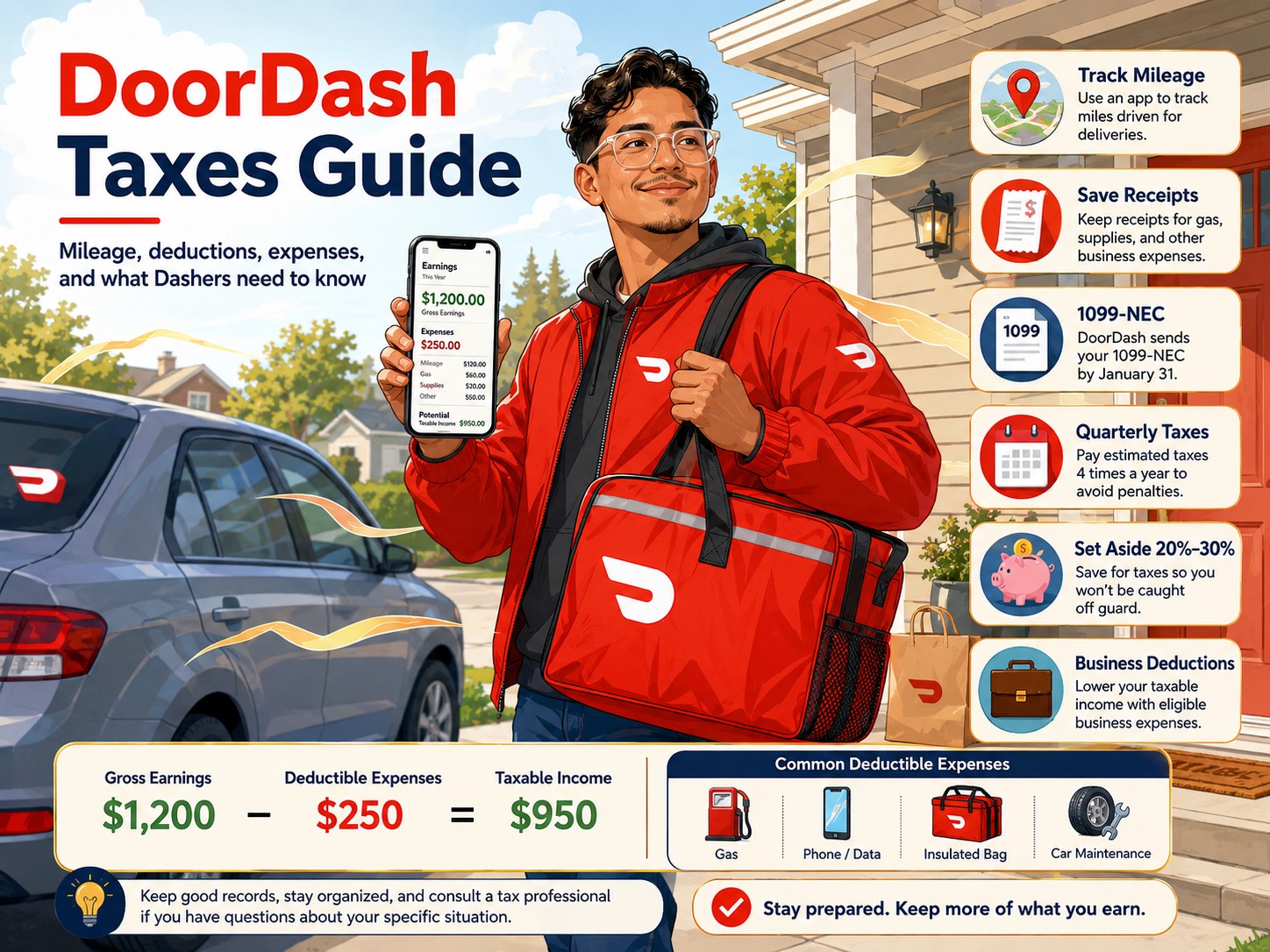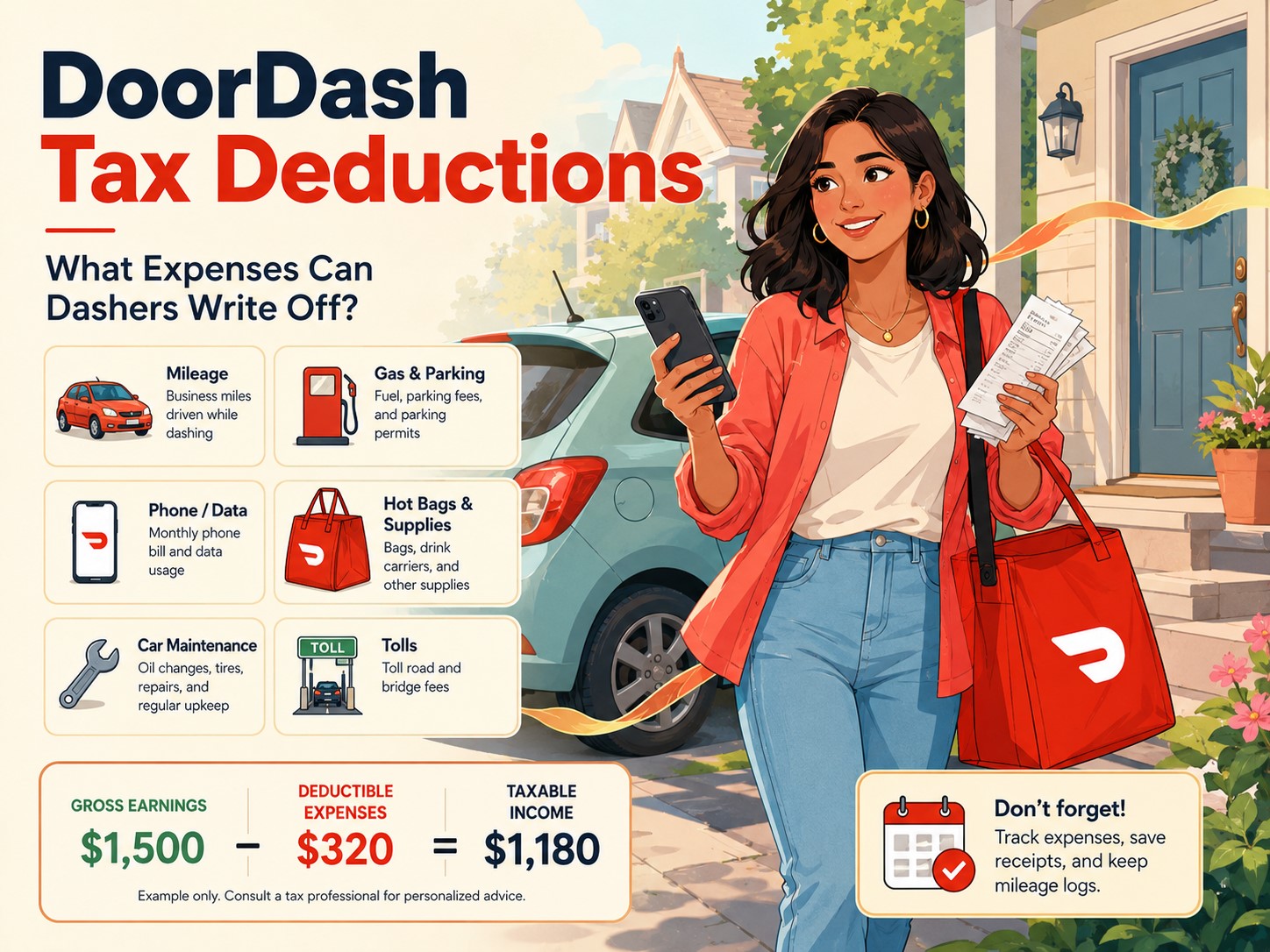
One of the biggest advantages of working as a DoorDash driver is that many of the expenses you incur while running your delivery business may be tax-deductible.
Mileage is usually the big one, but it is not the only possible deduction.
Depending on your situation, you may also be able to deduct expenses related to your phone, delivery bags, parking, tolls, accounting software, certain insurance costs and other ordinary expenses connected to your DoorDash work.
Understanding these deductions matters because, as an independent contractor, you are generally taxed on your business profit, not simply the amount that appears in your DoorDash Earnings tab.
Suppose you earned $30,000 from DoorDash during the year.
If you had $10,000 of legitimate deductible business expenses, your Schedule C profit could potentially be closer to $20,000 rather than $30,000.
That difference can affect both your federal income tax and self-employment tax.
However, there is an equally important warning:
A tax deduction does not mean the expense becomes free.
You still spent the money.
A deduction simply reduces the amount of income used in certain tax calculations.
This guide explains the most common DoorDash tax deductions for 2026, including mileage, gas, car expenses, phone costs, delivery equipment and other write-offs Dashers should know about.
This article provides general federal tax information. Your situation may be different depending on your state, income, vehicle, other employment and business activities. Consider consulting a qualified tax professional for advice about your specific return.
What Is a DoorDash Tax Deduction?
A tax deduction reduces taxable business income.
As a Dasher operating as a sole proprietor, you will generally report business income and expenses on Schedule C, Profit or Loss From Business.
The basic calculation looks like this:
Business income − deductible business expenses = net business profit
For example:
- DoorDash income: $25,000
- Business deductions: $8,000
- Net Schedule C profit: $17,000
Your taxes are then calculated using this profit along with your other income, deductions, credits and tax circumstances.
The IRS allows self-employed taxpayers to deduct expenses that are ordinary and necessary for carrying on a legitimate business. Schedule C is used to report those business expenses.
A Tax Deduction Is Not the Same as a Tax Credit
This distinction is important.
A deduction reduces the income subject to tax.
A tax credit directly reduces the amount of tax you owe.
Suppose you qualify for a $1,000 deduction.
That does not mean the IRS gives you $1,000.
If the deduction ultimately saves you $200 in tax, you received a $200 tax benefit from a $1,000 deduction.
This is why buying unnecessary equipment just because it is “tax-deductible” usually does not make financial sense.
Spend money because your business needs it, not merely because you may be able to deduct it.
The Biggest DoorDash Deduction: Your Vehicle
For most Dashers, vehicle costs are the largest business expense.
The IRS generally allows self-employed drivers to calculate deductible vehicle expenses using one of two methods:
- Standard mileage rate
- Actual vehicle expenses
If you qualify to use either method, the IRS recommends comparing the calculations because one may produce a larger deduction than the other.
You generally cannot claim the full standard mileage deduction and then deduct all your gas, repairs, insurance and depreciation again.
Those are two different ways of calculating vehicle costs.
Option 1: Standard Mileage Deduction
The standard mileage method is usually the easiest option for Dashers.
Instead of tracking every dollar spent on operating your car, you track qualifying business miles and multiply those miles by the IRS standard mileage rate.
There is an unusual change for 2026 because the IRS increased the business mileage rate halfway through the year.
2026 DoorDash mileage rates
- January 1 through June 30, 2026: 72.5 cents per business mile
- July 1 through December 31, 2026: 76 cents per business mile
The original 2026 rate was 72.5 cents per mile. The IRS raised it to 76 cents for business miles driven beginning July 1, 2026.
This means your 2026 mileage records should separate miles driven during the first and second halves of the year.
Example: 10,000 DoorDash Miles in 2026
Suppose you drove:
- 4,500 eligible business miles from January through June
- 5,500 eligible business miles from July through December
Your calculation would be:
January through June
4,500 × $0.725 = $3,262.50
July through December
5,500 × $0.76 = $4,180
Total mileage deduction
$7,442.50
That does not mean the IRS sends you $7,442.50.
It means you may potentially reduce your Schedule C business income by that amount, assuming all the miles qualify and you are eligible to use the standard mileage method.
What Does the Standard Mileage Rate Cover?
The standard mileage rate is intended to represent the cost of owning and operating the vehicle.
When you use standard mileage, you generally do not separately deduct ordinary vehicle operating expenses such as:
- Gas
- Oil
- Routine maintenance
- Repairs
- Tires
- Auto insurance
- Registration fees
- Depreciation
The IRS allows business-related parking fees and tolls to be deducted separately even when you use the standard mileage method. Certain business-use vehicle-loan interest may also be treated separately for a self-employed taxpayer.
This is one of the most common areas where new Dashers make mistakes.
You cannot normally say:
“I drove 10,000 miles, so I am deducting the mileage rate. I also spent $2,000 on gas, so I will deduct that too.”
The mileage rate already represents operating costs such as fuel.
Who Can Use the Standard Mileage Method?
There are rules.
For example, if you own the vehicle and want to use standard mileage, you generally need to choose the mileage method in the first year the vehicle is available for use in your business.
If you lease the vehicle and choose standard mileage, you generally must continue using that method throughout the lease period, including renewals.
Certain depreciation choices can also prevent you from using standard mileage later.
For a new Dasher with a normal personally owned vehicle, standard mileage is often the simplest starting point.
Option 2: Actual Vehicle Expenses
Instead of using mileage, you can potentially calculate the actual business portion of your vehicle costs.
The IRS lists actual vehicle costs such as:
- Gas
- Oil
- Repairs
- Tires
- Insurance
- Registration fees
- Licenses
- Depreciation
- Lease payments
When a vehicle is used for both DoorDash and personal driving, you must divide the costs between business and personal use.
Example of Actual Vehicle Expenses
Suppose your annual vehicle expenses were:
- Gas: $3,500
- Insurance: $1,800
- Repairs: $1,200
- Tires: $800
- Registration: $250
- Oil and maintenance: $750
- Depreciation: $3,000
Total:
$11,300
Now suppose 70% of your vehicle mileage was business-related.
A simplified estimate would be:
$11,300 × 70% = $7,910
Your actual deduction may be more complicated because depreciation rules and some other costs have special treatment.
This is where professional tax assistance can become valuable.
Standard Mileage vs. Actual Expenses
Here is a simplified comparison.
| Standard Mileage | Actual Expenses |
|---|---|
| Track qualifying business miles | Track business and total mileage |
| Multiply by IRS rate | Track actual vehicle costs |
| Easier recordkeeping | More detailed recordkeeping |
| Gas generally included | Gas separately included |
| Repairs generally included | Repairs separately included |
| Insurance generally included | Insurance separately included |
| Depreciation built into rate | Depreciation calculated separately |
| Tolls can be extra | Tolls can be extra |
| Business parking can be extra | Business parking can be extra |
Neither method automatically produces the largest deduction.
A Dasher using an older Toyota Prius with low operating costs may benefit significantly from standard mileage.
A driver with an expensive vehicle, large repair bills and high insurance costs may find actual expenses more competitive.
Calculate both when you are legally eligible to choose.
Which DoorDash Miles Can You Deduct?
This is one of the most important questions.
Not every mile driven on a day when you DoorDash is automatically deductible.
Qualifying business transportation can include mileage between business locations and mileage incurred while carrying on business. Ordinary commuting between home and a regular workplace is generally personal rather than business mileage.
For a Dasher, potentially qualifying mileage may include situations such as:
- Driving from a restaurant to a customer
- Driving from one restaurant to another during active business activity
- Driving between delivery areas for a legitimate business reason
- Driving from one delivery to the next
- Driving to buy business supplies
- Driving to a qualifying temporary business location
The rules surrounding the drive between your home and your first or last business location can be more complicated.
Can You Deduct Mileage From Home to Your First Order?
Not automatically.
Ordinary commuting is generally nondeductible.
However, transportation rules can change when your home qualifies as your principal place of business.
For example, the IRS says a home can potentially qualify as a principal place of business when you use part of it exclusively and regularly for administrative or management activities and have no other fixed location where you conduct substantial administrative or management work.
That means the answer to:
“Can I deduct every mile from the moment I leave my driveway?”
is not always a simple yes.
A tax professional can help determine where your deductible business mileage begins and ends based on your specific circumstances.
DoorDash Mileage Estimates
DoorDash currently says it sends eligible US Dashers an estimated mileage email by January 31 when they dashed by car and had on-delivery mileage.
That estimate can be helpful.
However, it should not necessarily replace your own mileage records because it may not capture every potentially qualifying business mile.
For example, your own records may contain legitimate mileage involving:
- Driving between orders
- Repositioning for business purposes
- Purchasing delivery equipment
- Other gig-work trips
Keep your own mileage log throughout the year.
How to Track DoorDash Mileage
You can use:
- Mileage-tracking apps
- A spreadsheet
- A notebook
- Odometer photographs
- GPS history
- A combination of methods
A mileage log should contain enough information to substantiate the business use of the vehicle. The IRS requires adequate records or other sufficient evidence supporting business vehicle expenses.
A simple log might look like this:
| Date | Start | End | Miles | Purpose |
|---|---|---|---|---|
| July 7 | 35,140 | 35,202 | 62 | DoorDash deliveries |
| July 8 | 35,225 | 35,278 | 53 | DoorDash deliveries |
| July 10 | 35,300 | 35,314 | 14 | Delivery supplies |
The most important habit is consistency.
Do not try to recreate 15,000 miles from memory next April.
1. Gas
Can DoorDash drivers deduct gas?
Yes, if you use the actual vehicle-expense method and appropriately allocate the cost between business and personal driving.
Gas is specifically included among the actual vehicle costs recognized by the IRS.
Can you deduct gas and mileage?
Generally, no.
If you claim standard mileage, fuel is already represented in that rate.
Choose the appropriate vehicle method instead of counting the same expense twice.
2. Oil Changes
Oil can be included under the actual vehicle-expense method.
Do not separately deduct oil when claiming standard mileage because vehicle operating costs are already represented by the mileage rate.
3. Car Repairs
Repairs attributable to business use can be part of the actual expense calculation.
Examples might include:
- Brake repairs
- Alternator replacement
- Suspension repairs
- Engine repairs
- Air-conditioning repairs
- Electrical repairs
When the car is also used personally, only the appropriate business portion is generally considered.
Do not add ordinary repairs on top of the standard mileage deduction.
4. Tires
Tires are another actual vehicle expense identified by the IRS.
This can matter for Dashers because delivery driving can put significant mileage on tires.
Again, this expense is generally incorporated into standard mileage when you choose that method.
5. Car Insurance
Automobile insurance can be included under the actual vehicle-expense method.
When you use the car for both personal and business purposes, you generally allocate the cost based on business use.
Standard mileage already represents ordinary vehicle operating costs, so you should not ordinarily add your normal personal auto-insurance premium on top of the mileage deduction.
6. Delivery or Commercial Insurance
Some drivers purchase additional insurance specifically because they perform delivery work.
Depending on how the policy is structured, a business-only insurance cost may potentially qualify as an ordinary business expense.
However, insurance treatment can become complicated when it overlaps with normal automobile coverage.
Keep your policy documents and ask a tax professional whether an additional delivery endorsement should be treated as:
- Part of actual vehicle costs
- A separate business insurance expense
- A mixed personal/business cost
7. Vehicle Registration and Licensing Fees
Registration fees and licenses are included among actual car expenses identified by the IRS.
When the vehicle has personal and business use, only the appropriate business portion may be deductible through the actual expense method.
Certain state personal-property taxes on a vehicle may have separate treatment.
8. Car Depreciation
Your car loses value as you drive it.
The actual expense method can potentially include depreciation for the business portion of the vehicle.
However, depreciation is one of the more complicated areas of vehicle taxation.
The IRS imposes limits on automobile depreciation, and choices involving MACRS, Section 179 and special depreciation allowances can affect whether you are allowed to use standard mileage in future years.
If you recently purchased an expensive vehicle primarily for delivery work, consider getting professional tax advice before choosing a depreciation method.
A larger first-year deduction is not always the best long-term decision.
9. Car Lease Payments
Lease payments can be included under the actual expense method to the extent attributable to business use.
Special rules can apply to leased vehicles, including limitations and inclusion amounts for certain higher-value cars.
If you choose standard mileage on a leased vehicle, you generally have to continue using standard mileage throughout the lease period.
10. Car-Loan Interest
A self-employed taxpayer may potentially deduct the business-use portion of interest paid on a vehicle loan.
The IRS specifically notes that car-loan interest may be deductible even when the taxpayer uses the standard mileage rate.
The important word is interest.
Your complete car payment is not automatically deductible.
A car payment normally contains:
- Principal
- Interest
The principal relates to purchasing the vehicle itself and is generally handled through vehicle basis and depreciation rules.
Do not simply multiply your monthly payment by 12 and call the entire amount a business expense.
11. Tolls
Business-related tolls may generally be deducted separately whether you use:
- Standard mileage, or
- Actual vehicle expenses.
For example, if an accepted delivery requires you to cross a toll bridge, that toll may be a business expense.
Keep:
- Toll statements
- Receipts
- Electronic toll-account history
Separate business tolls from personal trips.
12. Parking Fees
Parking paid for legitimate business activity can generally be deducted separately from the standard mileage allowance.
Examples could include paying to park while:
- Picking up an order
- Delivering to a downtown customer
- Purchasing business supplies
However, parking associated with ordinary commuting is not deductible business parking.
13. Parking Tickets and Traffic Fines
Do not confuse a parking fee with a parking fine.
A legitimate paid parking charge may qualify.
A ticket for illegally parking does not become a business deduction simply because you were delivering DoorDash at the time.
The same principle applies to:
- Speeding tickets
- Red-light violations
- Reckless-driving fines
- Other government penalties
Do not park illegally just because the pickup will take “only one minute.”
14. DoorDash Hot Bags
An insulated delivery bag purchased for your DoorDash business may potentially qualify as an ordinary and necessary business supply or equipment expense.
Examples include:
- Standard hot bags
- Catering bags
- Insulated grocery bags
- Thermal delivery backpacks
Keep your receipt.
You do not need to throw away inexpensive receipts merely because an item cost only $20.
15. Pizza Bags
Pizza bags purchased specifically for delivery work may also be a legitimate business expense.
This can include:
- Standard insulated pizza bags
- Large catering pizza bags
- Thermal liners
If DoorDash or a restaurant provides the bag for free, you cannot deduct an amount you never paid.
16. Drink Carriers
Reusable drink carriers can help prevent spills and make multiple-drink orders easier to manage.
A drink carrier purchased for business use may potentially qualify as a delivery supply.
Keep a receipt and record the business purpose.
17. Phone Mount
A phone mount is almost essential for many drivers because DoorDash relies heavily on navigation.
A mount purchased primarily for your delivery business may be deductible as ordinary business equipment.
If you purchase a more expensive integrated vehicle accessory that has significant personal use, allocation or capitalization issues may arise.
18. Phone Chargers and Power Banks
Delivery apps, GPS navigation and customer communication can drain a phone battery quickly.
Business-use accessories may potentially include:
- Car chargers
- Charging cables
- Wireless chargers
- Power banks
- Replacement adapters
Keep receipts for equipment you purchase for your delivery work.
19. Your Cell Phone Bill
Your smartphone is one of the most important tools in your DoorDash business.
You use it for:
- Receiving offers
- GPS navigation
- Contacting customers
- Contacting support
- Taking delivery photos
- Managing earnings
- Scheduling
- Tracking mileage
When a phone is used for both personal and business purposes, the reasonable business portion of the cost may potentially be deductible as an ordinary business expense.
For example:
Annual phone bill: $1,200
Estimated documented business use: 40%
Potential business portion:
$1,200 × 40% = $480
Do not automatically deduct 100% of your family cell-phone plan merely because you use your phone for DoorDash.
Your allocation should be reasonable and supportable.
20. Purchasing a Phone
A smartphone purchased for business use may potentially be deducted or depreciated depending on:
- Cost
- Business-use percentage
- Expected useful life
- Applicable depreciation and expensing rules
If the phone is also your personal phone, you generally need to allocate between business and personal use.
A dedicated business-only phone provides a clearer business connection.
21. Mileage-Tracking Apps
A paid subscription to an app used specifically for business mileage tracking can potentially be deductible.
Examples of the business function include:
- Recording mileage
- Categorizing trips
- Producing mileage reports
- Tracking business expenses
DoorDash itself encourages Dashers to maintain mileage information and says it provides eligible Dashers with mileage estimates for tax purposes.
22. Bookkeeping Software
Software used to manage your delivery business may qualify as an ordinary business expense.
Examples include software used for:
- Tracking income
- Categorizing expenses
- Scanning receipts
- Maintaining mileage records
- Preparing business reports
If you use software for multiple purposes, deduct only the appropriate business portion.
23. Tax-Preparation Fees
The portion of professional tax-preparation fees directly related to your DoorDash business may potentially be deductible as a business expense.
For example, your tax preparer may separately charge for:
- Schedule C
- Vehicle-expense calculations
- Bookkeeping
- Business tax consulting
- Estimated-tax preparation
Personal tax-return preparation and business tax preparation can receive different treatment, so keep an itemized invoice when possible.
24. Accountant or Bookkeeper
Fees paid to an accountant or bookkeeper for legitimate DoorDash business services can generally be business expenses when they are ordinary and necessary.
Possible services include:
- Monthly bookkeeping
- Mileage reconciliation
- Expense categorization
- Schedule C preparation
- Tax planning
- Estimated-tax calculations
A professional can also help you avoid claiming deductions you are not actually entitled to.
25. Business Bank Fees
If you maintain a separate account specifically for your DoorDash business, ordinary fees connected to that business account may potentially be deductible.
Examples might include:
- Monthly business-account fees
- Business transaction fees
- Business check fees
Personal overdraft fees do not automatically become deductible simply because DoorDash deposits money into the same account.
Using a separate business account can make bookkeeping much easier even when you are not legally required to create one.
26. Business Credit-Card Interest
Interest connected to legitimate business purchases may potentially be deductible.
For example, suppose you use a dedicated credit card to purchase:
- Delivery equipment
- Business software
- A business-only phone
Interest attributable to those business purchases may qualify.
When the same card contains personal purchases, you need to separate business interest from personal interest.
27. Flashlights
A flashlight purchased specifically to locate house numbers and safely navigate nighttime deliveries may be an ordinary delivery-safety expense.
Keep the receipt and document that it is used in your delivery work.
28. Reflective Safety Equipment
Business-specific safety equipment may potentially qualify.
Examples include:
- Reflective vest
- Reflective armband
- Safety light
- Bike-delivery safety equipment
Ordinary clothing that you could wear outside work is treated differently.
Buying a pair of normal sneakers does not automatically turn them into a DoorDash tax deduction.
29. Bicycle and E-Bike Expenses
Dashers who deliver by bicycle or e-bike may have deductible costs associated with operating and maintaining business equipment.
Possible expenses can include the business portion of:
- Bike repairs
- Tires
- Tubes
- Lights
- Locks
- Delivery racks
- Helmet and specialized safety equipment
- Maintenance
- Battery costs for an e-bike
If the bike is also used personally, appropriate allocation may be required.
Vehicle mileage rules for automobiles should not automatically be applied to bicycles.
30. Scooter or Motorcycle Expenses
Dashers using scooters or motorcycles may also have deductible business transportation costs.
Depending on the vehicle and tax method, these could include:
- Fuel
- Insurance
- Repairs
- Maintenance
- Tires
- Registration
- Depreciation
The IRS standard mileage rate discussed above is generally associated with the business use of a car, van, pickup or panel truck. Motorcycle and scooter expenses may need to be calculated differently.
Consult the applicable IRS guidance or a tax professional before applying the automobile mileage rate to a motorcycle.
31. Cleaning Supplies
Delivery-related cleaning supplies may potentially be deductible when they have a genuine business purpose.
Examples might include:
- Paper towels used to clean delivery spills
- Sanitizing products for delivery equipment
- Cleaning products used for hot bags
- Disposable liners for delivery equipment
Be reasonable.
Your complete household cleaning budget does not become deductible because you occasionally DoorDash.
32. Delivery Organizers
You may purchase equipment to organize orders inside your vehicle.
Potential examples include:
- Trunk organizers
- Bag dividers
- Cup organizers
- Storage bins used for delivery supplies
When used exclusively for business, the connection is relatively straightforward.
When also used for groceries or personal activities, allocate appropriately.
33. Dash Cameras
A dash cam used to document driving incidents and protect a delivery vehicle may potentially qualify as business equipment to the extent it is used in your business.
When the vehicle is also heavily used personally, a business-use allocation may be appropriate.
The method of deducting a more expensive device can depend on cost and depreciation rules.
34. Roadside Assistance
Roadside-assistance plans can help drivers dealing with:
- Flat tires
- Dead batteries
- Lockouts
- Breakdowns
- Towing
The business portion may potentially qualify as an actual vehicle-related cost.
Be careful when also claiming standard mileage because many vehicle operating expenses are already incorporated into that rate.
Ask a tax professional when you are unsure whether a separate roadside plan should be deducted in addition to mileage.
35. Business-Related Car Washing
Drivers sometimes ask whether they can deduct car washes.
If you use the actual vehicle-expense method and the cleaning is genuinely connected to maintaining the business vehicle, the appropriate business portion may potentially be considered with actual operating expenses.
If you use standard mileage, avoid automatically adding every routine vehicle-cleaning expense on top of the mileage deduction.
A special cleaning cost caused directly by the business may require different analysis.
For example, cleaning a major spill from a delivery may have a stronger separate business connection than your ordinary Saturday car wash.
36. Home Office
This deduction can be legitimate, but Dashers should be careful with it.
You do not automatically qualify for a home-office deduction because you:
- Check DoorDash earnings from your couch
- Schedule dashes from your bedroom
- Occasionally update a spreadsheet at your kitchen table
The IRS generally requires qualifying business use to be regular and exclusive.
A home office may potentially qualify as your principal place of business when it is used exclusively and regularly for administrative or management activities and you have no other fixed location where you substantially perform those activities.
Examples of DoorDash administrative activities might include:
- Bookkeeping
- Maintaining mileage records
- Managing tax documents
- Reviewing business expenses
- Maintaining delivery equipment
- Scheduling business activity
However, using the same desk for DoorDash bookkeeping, gaming and personal internet browsing can fail the exclusive-use test.
Simplified Home-Office Method
For taxpayers who qualify, the IRS simplified home-office option uses:
$5 per square foot
with a maximum of:
300 square feet
That creates a maximum simplified deduction of:
$1,500
The IRS also allows a regular method that allocates qualifying home expenses such as rent, utilities, insurance, maintenance and other costs based on business use.
Do not claim a home office simply because it sounds like an easy deduction.
The eligibility rules matter.
37. Internet Service
When you maintain a legitimate home office or use home internet for substantial DoorDash business administration, part of the cost may potentially qualify as a business expense.
Examples of business use could include:
- Downloading earnings statements
- Maintaining accounting records
- Filing taxes
- Managing business documentation
- Researching delivery zones
Most people also use internet service personally, so a reasonable allocation is usually necessary.
Do not deduct your entire household internet bill merely because you sometimes log into DoorDash.
38. Office Supplies
Supplies used specifically for managing your delivery business may qualify.
Examples include:
- Printer paper
- Ink
- Receipt folders
- Mileage notebooks
- Pens
- Labels
- Business filing supplies
The cost should have a legitimate connection to your business.
39. Printer
If you purchase a printer primarily to handle business records, mileage logs and tax documents, the business-use portion may potentially qualify.
More expensive equipment may need to be depreciated or treated under applicable expensing rules rather than automatically deducted immediately.
40. Self-Employed Health Insurance
This is not normally a Schedule C operating expense, but it can still be an important deduction for eligible self-employed Dashers.
Self-employed taxpayers may qualify for a separate deduction related to eligible health-insurance premiums.
The IRS provides Form 7206, Self-Employed Health Insurance Deduction, for calculating this deduction when applicable.
Potential coverage can involve eligible premiums for:
- Yourself
- Your spouse
- Dependents
Income and eligibility limitations apply.
For example, eligibility may be affected when you or your spouse could participate in subsidized employer health coverage.
This deduction should not simply be entered as ordinary auto or delivery expenses.
41. Retirement Contributions
Saving for retirement can also produce tax benefits.
Self-employed workers may potentially establish retirement plans such as:
- SEP IRA
- Solo 401(k)
- SIMPLE IRA
Contribution limits and deductions depend on the type of plan and your self-employment earnings.
The IRS specifically recognizes tax-favored retirement options for self-employed individuals and notes that eligible employer contributions can be deductible.
This is not the same thing as a normal Schedule C delivery expense, but it can reduce taxes while helping you build retirement savings.
42. Qualified Business Income Deduction
Eligible self-employed Dashers may also benefit from the Qualified Business Income deduction, commonly called the QBI or Section 199A deduction.
The deduction can generally be worth up to 20% of qualifying business income, subject to taxable-income and other limitations.
Federal legislation made the QBI deduction permanent and changed certain limits beginning with 2026.
The QBI deduction is calculated separately from ordinary Schedule C expenses.
In other words:
- Mileage reduces your business profit.
- Delivery equipment reduces business profit.
- The QBI deduction can provide an additional deduction based partly on qualifying business income.
Do not simply subtract 20% directly from DoorDash gross earnings.
The calculation is more complicated and can be affected by other deductions and taxable income.
43. Qualified DoorDash Tips Deduction
Eligible DoorDash drivers may also qualify for the federal deduction for qualified tips.
This is another important distinction:
The tip deduction is not a business expense.
You still report your tip income.
Beginning with qualifying tips received under the new federal rules, eligible taxpayers can claim a separate deduction of up to $25,000 per return, subject to income limits and other requirements. The IRS has confirmed that qualified tips received by eligible self-employed individuals can qualify when the applicable requirements are satisfied.
DoorDash currently says US Dashers receive separate information about their total tip income because tip amounts are needed for this deduction.
The tip deduction does not mean:
- DoorDash base pay becomes tax-free
- Peak Pay becomes tax-free
- Bonuses become tax-free
- Every gratuity automatically qualifies
- Self-employment tax disappears
Treat this separately from your Schedule C expense deductions.
What DoorDash Drivers Usually Cannot Write Off
Understanding what you cannot deduct is just as important.
Regular Meals While Dashing
Buying yourself lunch during a normal delivery shift does not automatically become a business deduction.
You would have needed to eat whether or not you were DoorDashing.
Business meal rules generally require a legitimate qualifying business or business-travel purpose.
Your normal Chipotle meal between deliveries is usually personal.
Coffee and Energy Drinks
The same principle applies to:
- Coffee
- Soda
- Energy drinks
- Snacks
- Bottled water purchased for yourself
Needing caffeine to finish a Friday-night dash does not automatically transform a personal drink into an ordinary business deduction.
Regular Clothing
Normal clothing that can be worn outside your delivery work is generally personal.
Examples include:
- T-shirts
- Jeans
- Hoodies
- Sneakers
- Jackets
- Hats
Specialized protective or safety equipment can be different.
Traffic Tickets
You cannot normally deduct government fines simply because they occurred while DoorDashing.
Examples include:
- Speeding tickets
- Parking citations
- Red-light violations
- Illegal-turn tickets
Personal Mileage
You cannot deduct driving that is personal.
Examples include:
- Visiting friends
- Grocery shopping for yourself
- Vacation trips
- Driving children to school
- Personal restaurant trips
- Social activities
Keeping the Dasher app installed on your phone does not turn all vehicle mileage into business mileage.
Personal Car Expenses
If you use the actual expense method and your vehicle is 60% business and 40% personal, you generally cannot deduct the personal 40%.
You must allocate mixed-use costs.
Your Entire Phone Bill
When the phone is used for both DoorDash and personal purposes, the personal portion is not a business deduction.
Your Entire Home Internet Bill
The same applies to internet service.
Only legitimate business use may qualify.
Your Entire Car Payment
A car loan payment is not automatically an expense.
Principal, interest and depreciation have different tax treatment.
Gas Plus Mileage
One of the most common mistakes.
Do not claim:
- Standard mileage, plus
- All your gas, plus
- All repairs, plus
- All insurance
The standard mileage rate is already intended to represent normal vehicle ownership and operating costs.
DoorDash Deduction Example
Suppose a Dasher has the following 2026 results:
Earnings
DoorDash gross income:
$35,000
Mileage
January through June:
5,000 business miles
July through December:
6,000 business miles
First-half deduction
5,000 × $0.725 = $3,625
Second-half deduction
6,000 × $0.76 = $4,560
Total mileage
$8,185
Other potential business expenses
- Business phone portion: $500
- Hot bags and delivery supplies: $250
- Mileage-tracking software: $100
- Business parking: $200
- Business tolls: $300
- Business tax-preparation fees: $250
Total other expenses:
$1,600
Simplified Schedule C calculation
Gross DoorDash income:
$35,000
Minus mileage:
− $8,185
Minus other business expenses:
− $1,600
Estimated Schedule C profit:
$25,215
The driver potentially reduced business profit by:
$9,785
The driver could then have additional tax calculations involving:
- Deduction for one-half of self-employment tax
- Qualified-tip deduction
- QBI deduction
- Self-employed health-insurance deduction
- Retirement contributions
- Standard or itemized deduction
- Tax credits
That is why your final taxable income can be very different from the amount shown on your DoorDash 1099.
What Receipts Should DoorDash Drivers Keep?
Keep documents supporting both income and deductions.
Examples include:
Vehicle
- Mileage logs
- Fuel receipts if using actual expenses
- Repair invoices
- Tire receipts
- Insurance statements
- Registration
- Vehicle-purchase documents
- Loan-interest statements
- Lease documents
- Maintenance receipts
Delivery equipment
- Hot-bag receipts
- Pizza-bag receipts
- Drink carriers
- Phone mounts
- Chargers
- Safety equipment
- Organizers
Technology
- Phone bills
- Internet bills
- Mileage-app subscriptions
- Accounting software
- Business phone purchases
Professional services
- Tax-preparation invoices
- Accountant bills
- Bookkeeping fees
Transportation
- Toll statements
- Parking receipts
DoorDash records
- Monthly earnings statements
- Form 1099-NEC
- Tip-income information
- Mileage estimate
DoorDash currently lets Dashers download monthly earnings statements through the Dasher app and provides eligible Dashers with 1099 tax documents by January 31.
Keep Business and Personal Expenses Separate
One of the easiest ways to simplify DoorDash taxes is to separate your business spending.
Consider using:
- A separate checking account
- A dedicated credit card
- A separate tax savings account
You do not necessarily need a complicated business structure.
The goal is organization.
Imagine reviewing one bank statement containing:
- DoorDash deposits
- Hot-bag purchases
- Personal groceries
- Netflix
- Gas
- Restaurant meals
- Vacation spending
- Phone bill
- Car repair
- Clothing
- Rent
Now imagine trying to identify the business expenses a year later.
Separating business spending saves time and reduces mistakes.
Create a Monthly DoorDash Tax Routine
Taxes become difficult when you ignore them for 12 months.
Once a month:
- Download your DoorDash earnings statement.
- Review your mileage log.
- Save receipts.
- Categorize expenses.
- Reconcile your bank account.
- Record cash tips.
- Review your tax savings.
- Back up everything.
You might spend 30 minutes each month instead of spending several frustrating days trying to reconstruct an entire year.
Sample Expense Categories for Dashers
Create categories such as:
Vehicle
- Mileage
- Gas
- Maintenance
- Repairs
- Insurance
- Registration
- Depreciation
Delivery equipment
- Hot bags
- Pizza bags
- Drink carriers
- Organizers
- Safety gear
Technology
- Phone
- Phone accessories
- Internet
- Software
- Mileage tracking
Transportation
- Tolls
- Parking
Professional services
- Accounting
- Bookkeeping
- Tax preparation
Other
- Business supplies
- Qualified home-office costs
- Business insurance
- Other legitimate business expenses
This makes Schedule C preparation much easier.
Should You Use a Mileage App?
For many Dashers, yes.
Automatic mileage tracking can reduce the risk of forgetting trips.
However, review your records.
An app may incorrectly classify:
- Personal grocery trips
- Vacation driving
- School pickups
- Visits to friends
It can also miss legitimate trips when:
- GPS permissions fail
- Your phone battery dies
- Background tracking is turned off
- You change devices
Technology helps with recordkeeping, but you remain responsible for making sure the tax records are accurate.
Should You Save Gas Receipts When Using Standard Mileage?
You generally do not need gas receipts to calculate the standard mileage deduction because fuel is already reflected in the mileage rate.
However, I still like the idea of tracking actual vehicle expenses.
Why?
Because it helps you understand whether DoorDash is actually profitable.
Your tax deduction and your real vehicle cost are not the same thing.
Suppose the IRS mileage rate is 76 cents per mile but your vehicle actually costs you 35 cents per mile to operate.
That difference can make standard mileage attractive for tax purposes.
Or perhaps you have an expensive vehicle with:
- Major repairs
- High insurance
- Poor fuel economy
- Significant depreciation
Knowing your actual costs helps you decide whether your vehicle is suitable for delivery work and whether the actual expense method deserves consideration.
Tax Deduction vs. Real Profit
This deserves extra attention.
Imagine you drive 100 business miles and receive a mileage deduction based on the applicable IRS rate.
That does not mean you made money by driving 100 miles.
You still had:
- Fuel usage
- Tire wear
- Engine wear
- Depreciation
- Maintenance
- Insurance
- Time
A deduction reduces taxes.
It does not eliminate expenses.
Your goal should always be:
Earn more revenue than the real cost of operating your business.
Do not accept an unprofitable 20-mile DoorDash order simply because the mileage might be deductible.
Losing $10 to save $2 or $3 in taxes is still losing money.
Common DoorDash Tax Deduction Mistakes
1. Not Tracking Mileage
Mileage can be one of your largest deductions.
Forgetting to track it can cost you.
2. Deducting Gas and Mileage Together
Choose the correct vehicle-expense method.
Do not double-count ordinary vehicle expenses.
3. Deducting Every Mile From Home
Some driving may be nondeductible commuting.
Home-office and transportation rules can affect where business mileage begins.
4. Claiming 100% Business Use Without Proof
If you use your phone or vehicle personally, claiming 100% business use may be difficult to support.
5. Throwing Away Receipts
Small expenses add up.
6. Treating Personal Meals as Business Expenses
Eating while you work does not automatically make the food deductible.
7. Deducting Normal Clothing
Regular clothing does not become business equipment simply because you wear it while DoorDashing.
8. Deducting Traffic Tickets
Government fines are different from ordinary business expenses.
9. Claiming a Home Office Without Meeting the Rules
Occasional use is not enough.
The IRS generally requires regular and exclusive qualifying use.
10. Spending Money Just for the Deduction
A $500 business purchase does not save you $500 in taxes.
Buy equipment because it improves your business.
11. Ignoring Smaller Deductions
Mileage may be the largest expense, but smaller legitimate deductions can add up.
12. Mixing Business and Personal Records
Separate accounts and categories make tax preparation much easier.
DoorDash Tax Deduction Checklist
At the end of the year, review whether you have legitimate records for:
- Business mileage
- Gas if using actual expenses
- Repairs if using actual expenses
- Maintenance if using actual expenses
- Tires if using actual expenses
- Auto insurance if using actual expenses
- Registration if using actual expenses
- Vehicle depreciation if applicable
- Business parking
- Business tolls
- Car-loan business interest
- Hot bags
- Pizza bags
- Drink carriers
- Delivery organizers
- Phone mount
- Chargers
- Power bank
- Business phone percentage
- Mileage apps
- Accounting software
- Tax-preparation fees
- Bookkeeping fees
- Business bank fees
- Business credit-card interest
- Safety equipment
- Bicycle or e-bike expenses
- Other ordinary delivery supplies
- Qualified home-office expenses
- Self-employed health-insurance eligibility
- Retirement contributions
- QBI deduction eligibility
- Qualified-tip deduction eligibility
Do not claim something merely because it appears on this list.
Your expense still needs to meet the applicable tax rules and relate legitimately to your business.
Frequently Asked Questions
What can DoorDash drivers deduct on taxes?
Common potential deductions include mileage or actual vehicle expenses, business parking, tolls, delivery bags, phone costs, business software, equipment and other ordinary expenses connected to operating the delivery business.
Can DoorDash drivers deduct mileage?
Yes, qualifying business mileage can potentially be deducted.
For 2026, the IRS business mileage rate is 72.5 cents per mile through June 30 and 76 cents per mile beginning July 1.
Can you deduct gas for DoorDash?
Yes, if you use the actual vehicle-expense method and calculate the appropriate business portion.
Gas is not separately added when you use standard mileage.
Can I write off mileage and gas?
Generally not for the same vehicle and tax period.
Standard mileage represents fuel and other normal operating costs.
Can I deduct my car payment?
Not as one simple monthly expense.
Vehicle principal, depreciation and loan interest have different tax treatment. Eligible self-employed drivers may potentially deduct the business portion of vehicle-loan interest.
Can I deduct car insurance?
Car insurance can be included when using actual vehicle expenses and allocating the appropriate business percentage.
Can I deduct repairs?
Yes, qualifying business-use vehicle repairs may be included under the actual expense method.
Do not separately add routine repairs when using standard mileage.
Can I deduct tires?
Tires are included among actual vehicle expenses recognized by the IRS.
Can I deduct oil changes?
Oil and vehicle operating expenses may be included under the actual method.
They are generally already represented when you claim standard mileage.
Can I deduct parking?
Business-related parking fees may generally be deducted separately even when claiming standard mileage.
Can I deduct tolls?
Business-related tolls can generally be deducted separately with either vehicle-expense method.
Can I deduct parking tickets?
Do not confuse parking fees with government fines. A legitimate business parking charge can qualify, but a citation for illegal parking is not an ordinary deductible parking expense.
Can I deduct my phone bill?
The reasonable business-use portion of a phone used for DoorDash may potentially qualify as an ordinary business expense.
Keep records supporting your allocation.
Can I write off a new phone?
The business portion may potentially be deductible or depreciable depending on cost, use and applicable tax rules.
Can I deduct a DoorDash hot bag?
A delivery bag purchased specifically for business use may potentially qualify as a business supply or equipment expense.
Can I deduct a pizza bag?
Potentially, yes, when you purchased it for business use and were not reimbursed.
Can I deduct a phone mount?
A mount purchased primarily for DoorDash navigation may potentially qualify as business equipment.
Can I deduct my meals while DoorDashing?
Your ordinary personal meals during a local dash generally do not become deductible merely because you were working.
Can I deduct coffee while DoorDashing?
Ordinary coffee and drinks purchased for yourself are generally personal rather than business expenses.
Can I deduct clothes I wear while dashing?
Regular clothing such as jeans, shirts, jackets and sneakers is generally personal.
Specialized protective equipment may receive different treatment.
Can I deduct DashPass?
Normally, a personal DashPass subscription would not automatically become a DoorDash driver expense. You would need a legitimate ordinary and necessary business reason for the cost.
Can I deduct my home office?
Possibly, but the requirements are strict.
The IRS generally requires regular and exclusive qualifying business use. An area used for administrative or management activities may qualify when your home is your principal place of business and other requirements are met.
Can I deduct internet service?
The reasonable business portion may potentially qualify when it is used for genuine business activities.
Can I deduct tax-preparation fees?
The business-related portion of accounting or tax-preparation services may potentially be deductible.
Does DoorDash give me my mileage?
DoorDash says it sends eligible US Dashers a mileage estimate by January 31 when they dashed by car and had on-delivery mileage.
Maintain your own records because your complete potentially qualifying business mileage may differ.
Do I need receipts if I claim mileage?
You need adequate records supporting your business mileage. The IRS requires taxpayers to substantiate vehicle expenses with appropriate records or other sufficient evidence.
What if I forgot to track my mileage?
Do not invent a number.
Try reconstructing the most accurate record possible using existing evidence such as:
- DoorDash mileage estimates
- Delivery history
- Earnings statements
- GPS history
- Calendar records
- Vehicle-service records
- Odometer photos
Then begin keeping a contemporaneous mileage log immediately.
Is the DoorDash tip deduction the same as a business write-off?
No.
Eligible qualified tips may receive a separate federal deduction, but the tip income is still reported. DoorDash now provides US Dashers with separate tip information for this purpose.
Can Dashers get the QBI deduction?
Eligible sole proprietors may potentially qualify for the Section 199A Qualified Business Income deduction. Federal legislation has made the deduction permanent and adjusted certain rules beginning in 2026.
Should I use standard mileage or actual expenses?
Calculate both when you qualify to choose.
The IRS specifically suggests comparing the two methods because the larger deduction depends on your vehicle and expenses.
Should I hire a tax professional?
Consider professional help when:
- You drive for several apps
- You purchased or sold a vehicle
- You want to use actual vehicle expenses
- You have large repairs
- You want to claim depreciation
- You changed vehicles during the year
- You are unsure which mileage qualifies
- You want to claim a home office
- You received an IRS notice
- You have substantial DoorDash income
- You need help with quarterly taxes
- You have income in multiple states
Final Thoughts
DoorDash drivers can potentially claim many legitimate tax deductions, but the biggest one for most Dashers will still be vehicle expenses.
For many drivers, that means tracking every qualifying business mile.
And in 2026, recordkeeping is especially important because there are two different business mileage rates:
- 72.5 cents per mile from January through June
- 76 cents per mile from July through December
Beyond mileage, pay attention to legitimate business expenses such as:
- Parking
- Tolls
- Delivery bags
- Phone costs
- Business software
- Equipment
- Accounting
- Other necessary delivery supplies
But do not become so focused on deductions that you start trying to turn every personal expense into a business expense.
Your ordinary lunch is still lunch.
Your vacation is still personal travel.
Your normal clothes are still clothes.
And a speeding ticket does not become a business strategy just because you were delivering an order.
Good tax planning is really about accurate recordkeeping.
Track your mileage. Save receipts. Separate your business and personal expenses. Download your DoorDash statements. Review your records every month.
When you do those things consistently, you will have a much easier time claiming the deductions you legitimately earned without guessing when tax season arrives.
The goal is not to find every possible loophole.
The goal is to keep accurate records, claim the deductions the law actually allows and keep more of the profit you worked hard to earn.